Showing posts with label experiment. Show all posts

7.3.17

Sink or Float?

Students of Year 3 have been working on this experiment today. The purpose was to make and test predictions about sinking and floating and then classify objects according to weather they sink or float. Here there are some photos of the science class.


20.10.16

EXPERIMENTS IN THE SCIENCE LAB

Students of year 1 have been visiting the Science Lab with the teacher in charge of that room, D.Manuel. They have had a good time watching amazing experiments and listening to different entertaining stories. Here there are some pictures of the experience.


 Experiments in the Science Lab

26.11.15

THE FIVE SENSES

Taste, smell, sight, hearing and touch
are the five senses. Our bodys are so amazing that senses can combine to give us a fuller experience.

Students of year 6 have worked this topic at school through some experiments.


13.11.13

THE SCIENTIFIC METHOD

Scientists use the scientific method to find answers to questions and to solve problems. It is based on making observations, asking questions and looking for answers to questions through science experiments.
 
These are the main steps of the Scientific Method:

Steps of the Scientific Method for Kids
  1. Ask a question
  2. Gather information and observe (research)
  3. Make a hypothesis (guess the answer)
  4. Experiment and test your hypothesis
  5. Analyze your test results
  6. Present a conclusion


18.2.13

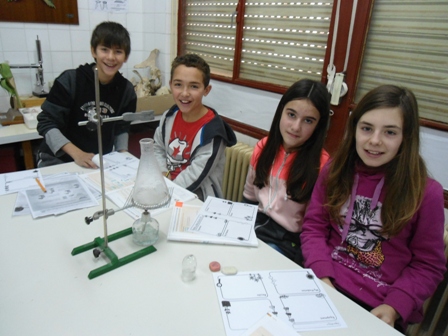
SEPARATION OF SAND AND SALT FROM WATER

1. We needed a bowl, a beaker, a funnel and filter paper and a burner.

BEAKER
BURNER

FUNNEL
FILTER PAPER


2. We put some salt into the bowl and made a solution.


3. We added some sand and made a mixture.


4. We poured the mixture through the funnel and filter paper (sieve) into a baker.


5. The solution filtrated.


6. We heated the solution in the beaker. (flask)


7. The water evaporated.


YEAR 6A GROUPS:


YEAR 6B GROUPS:


19.12.12

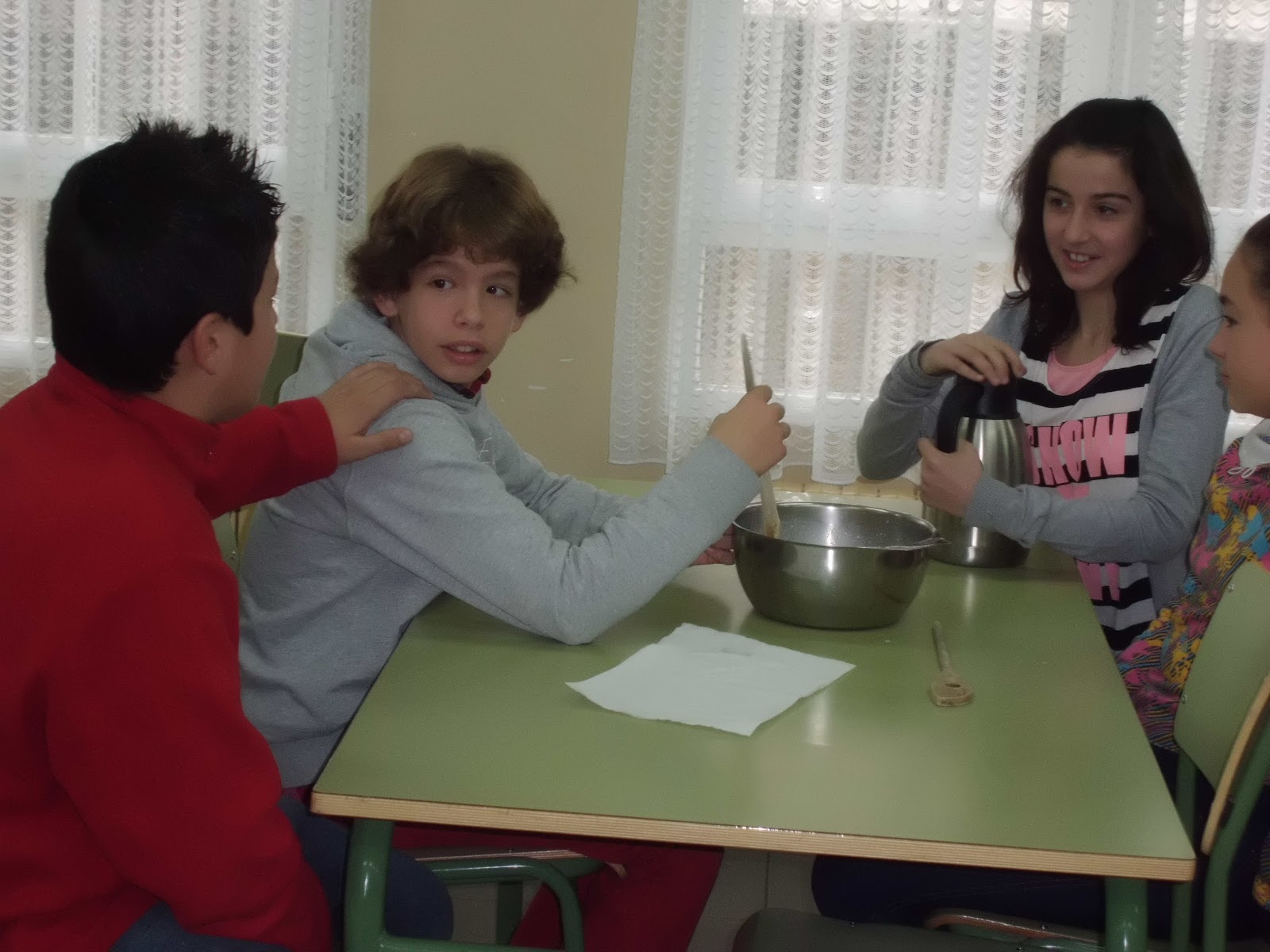
REPORT: MAKING YOGHURT

Milk goes bad quicky, but we can preserve it by making yoghurt. We use a process called fermentation to make it. In this process bacteria change the carbohydrates in the milk into acid. The acid stops other micro-organisms growing in the food.

1. We needed a vacuum flask, some fresh milk, a pot of natural yoghurt, a gas hob, a pan, a wooden spoon and a bowl for the finished yoghurt.


2. We poured the milk into the pan and we let it heat to 30ºC. We stirred the milk and we didn't let it get too hot!


3. We let the milk cool a little. Then we added the natural yoghurt.


We stirred the mixture for about two minutes.

 
4. We put the mixture into a vacuum flask and we closed the lid.
 
 
5. We waited for twelve hours.


6. We opened the flask and we poured the yoghurt into a bowl.

 
7. We kept the yoghurt in the fridge.