15.11.13

DO YOU KEEP HEALTHY?

1. Can you identify healthy foods in these pictures?


2. Watch this video about healthy and unhealthy food:
 
 
3. Can you name 5 vegetables and 10 fruits? Write your answers.
 
 
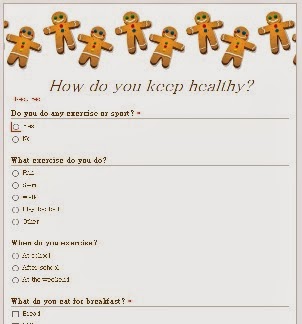
4. Answer this questionnaire:
 
https://docs.google.com/forms/d/11LC9K9wveM9IzdhF2bNnMbGLf2TQ_nVloNe3YQte590/viewform


13.11.13

THE SCIENTIFIC METHOD

Scientists use the scientific method to find answers to questions and to solve problems. It is based on making observations, asking questions and looking for answers to questions through science experiments.
 
These are the main steps of the Scientific Method:

Steps of the Scientific Method for Kids
  1. Ask a question
  2. Gather information and observe (research)
  3. Make a hypothesis (guess the answer)
  4. Experiment and test your hypothesis
  5. Analyze your test results
  6. Present a conclusion


18.2.13

SEPARATION OF SAND AND SALT FROM WATER

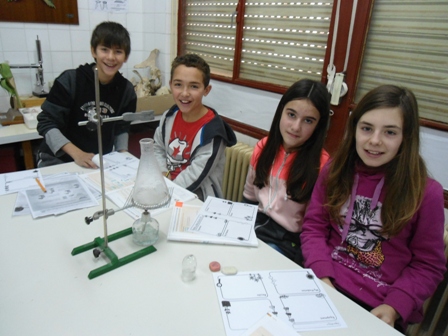
1. We needed a bowl, a beaker, a funnel and filter paper and a burner.

BEAKER
BURNER

FUNNEL
FILTER PAPER


2. We put some salt into the bowl and made a solution.


3. We added some sand and made a mixture.


4. We poured the mixture through the funnel and filter paper (sieve) into a baker.


5. The solution filtrated.


6. We heated the solution in the beaker. (flask)


7. The water evaporated.


YEAR 6A GROUPS:


YEAR 6B GROUPS:


PREZI PRESENTATIONS

Students from Year 6 have learnt to create Prezis in order to present their Science Projects. Here you have a short tutorial to get started with it:
Patricia & Marina (6B)

Luis, Raúl & Jose (6A)
Ana & Celia (6B)
Javier A. & Jorge (6B)

Javier G., Francisco & Diego V. (6A)
Lucas, Domingo & Alan (6A)
Mónica & María del E. (6B)
Carlos & Iker (6B)
David C. & Mario (6B)
Andrea Ab., Lesly & Minerva (6A)
Andrea F. & Diana (6B)
Melany, Natalia A. & Diana (6A)
Andrea Al., Laura & Sara (6A)

Liseth & María S. (6B)
David R. & Diego P. (6B)

Miguel & Alejandro (6B)
Alfonso, Nuño & Marcos (6A)
María M., Paula & Natalia D. (6A)
Raúl S. & Manuel (6B)

17.1.13

WHAT IS MATTER?

Matter is everything around you. Matter is anything made of atoms and molecules. Matter is anything that has mass and takes up space.

The States of Matter:


Mass and Weight are not the same!!!

19.12.12

CELLS


REPORT: MAKING YOGHURT

Milk goes bad quicky, but we can preserve it by making yoghurt. We use a process called fermentation to make it. In this process bacteria change the carbohydrates in the milk into acid. The acid stops other micro-organisms growing in the food.

1. We needed a vacuum flask, some fresh milk, a pot of natural yoghurt, a gas hob, a pan, a wooden spoon and a bowl for the finished yoghurt.


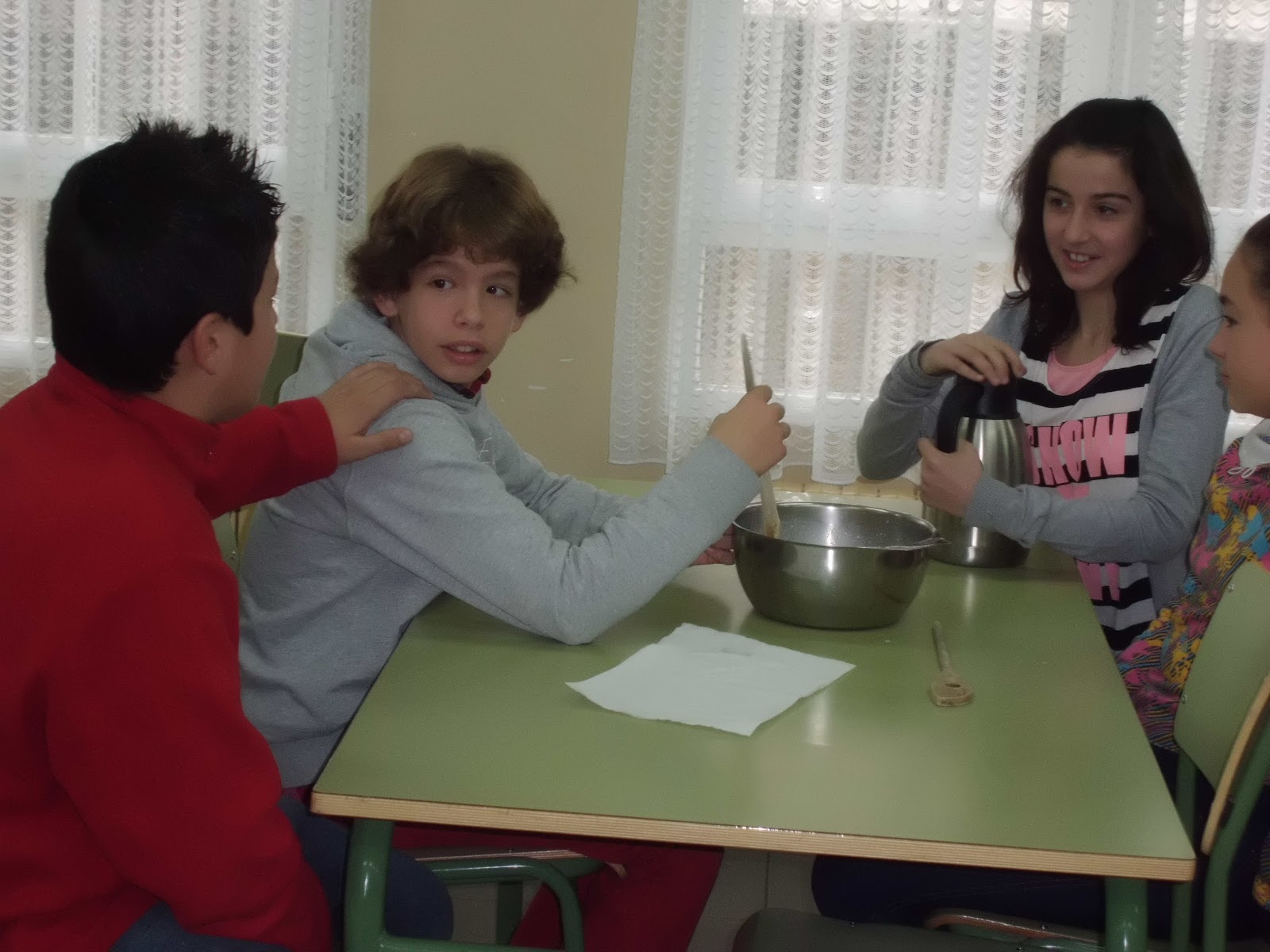
2. We poured the milk into the pan and we let it heat to 30ºC. We stirred the milk and we didn't let it get too hot!


3. We let the milk cool a little. Then we added the natural yoghurt.


We stirred the mixture for about two minutes.

 
4. We put the mixture into a vacuum flask and we closed the lid.
 
 
5. We waited for twelve hours.


6. We opened the flask and we poured the yoghurt into a bowl.

 
7. We kept the yoghurt in the fridge.